Postcards from France
Email us to order our CD
 Program Notes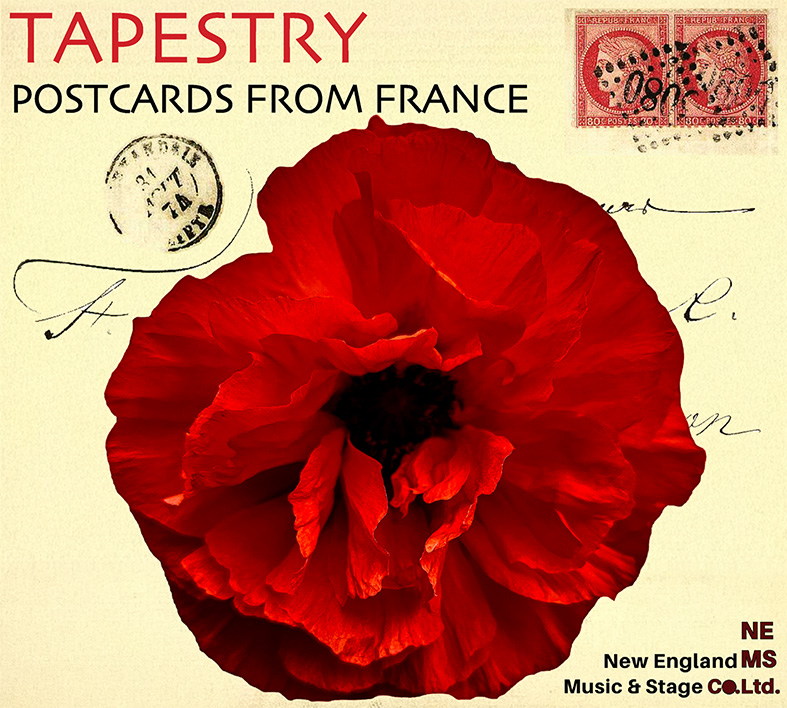
Recorded in 2025 at Q Division Studios, Cambridge, MA. Recording, mixing and mastering engineer: Joel Edinberg Project concept: Cristi Catt & Daniela Tosic Producers: Cristi Catt & Daniela Tosic Cover design: Margaret Cushing & Daniela Tosic
Tapestry is represented by Shupp Artists Management, Inc. and is part of the artist collaborative New England Music & Stage Co. Ltd./ NEMS Co. Ltd. www.tapestryboston.com
@tapestrybos
Special thanks to our engineer Joel Edinberg for his expertise and understanding, Margaret Cushing for her beautiful album cover art, CD booklet and web design, Ruthie Ristich for co-producing "Les Berceaux (Sail Away)" and "Chanson de grand-père /Les danses de Lormont," Allison Lund and Big and Little Productions for "Les Berceaux (Sail Away)" videography and video editing, Brenda Gooctwin of Cambridge, MA for loaning her 1912 Martin 0-21 guitar, featured on "L'heure exquise," Anastasia Krachkovskaya and Kira Johnson for their photos, our families for their endless support and patience with this project, Erica and Mona Shupp for believing in us, and to our dear co-founder and long time collaborator Laurie Monahan.
The “postcards” on this album are the result of good times, travels, and collaborations. Cristi and Daniela picked songs and worked out vocal arrangements to bring into rehearsals. Jerry and Andrew listened and added textures and grooves under the vocals. Songs took on their own life with dance tunes and interludes woven in between. James swooped in from Seattle to layer in improvisations and inspire new directions. We laughed a lot. Pieces continued to evolve through performances and studio recordings.
Tourdion*
Anon., c. 1530 (Burgundy)
We begin our tour of France with a lively dance, inviting all to a feast of delicious food and fine wine. Tourdion or Tordion (from the French verb "tordre" / to twist), was a popular dance tune similar to a gaillard. Popular from the mid-15th to the late-16th centuries, it appears in Pierre Attaignant's first publication of collected dances in 1530.
Gnossienne 1 (A Dream of Satie)
Erik Satie (1866–1925), arranged by James Falzone
Falzone writes: “Composer Erik Satie roamed the streets of the Montmartre neighborhood in Paris during the late 19th and early 20th centuries. A known eccentric, his odd habits included eating only white foods and collecting umbrellas, thousands of which were discovered in his tiny apartment when he died. All along, he composed remarkably beguiling melodies, especially his popular “Gymnopodie” and "Gnossienne”. My all-clarinet version of “Gnossienne No. 1” is meant to bring out the dreamy, surrealist qualities of Satie's music, as if we have stopped in a smoke-filled bar, late at night, where Monsieur Satie is playing piano, a glass of his favorite absinthe at his side.”
Je te veux*
Erik Satie (1866–1925)
Eric Satie immersed himself in the popular music of the Belle Epoque, working as an
accompanist at Le Chat Noir. He wrote “Je te veux” for Paulette Darty, a famous chanteuse and actress of the day. They first performed this valse chanté together in 1903 at La Scala, a popular cabaret in Paris.
Loup de neiges
Jeremiah McLane
McClane writes: “Far away on a distant shore, there was a very small village, and in the village lived a young boy whose parents were away much of the day. While his parents were at work, the boy would try out various musical instruments in the house. At first he felt lonely, wishing his friends could come play music with him, but then one day he was playing a song at the window and he saw a lone wolf approach through the snow. It sat directly below the window and seemed to listen as the boy played. Each day the wolf would return as the boy played and while the wolf sat listening, the boy felt less alone. And who knows, maybe the wolf did as well…”
Montagnarde de Pontgibaud / Chanson de grand-père / Chancelade / Les danses de Lormont*
Traditional, Auvergne / Max Arham (fl. 1911–1917) / Traditional, Nouvelle-Aquitaine / César Franck (1822–1890)
Our arrangement of César Frank’s vocal duet “Les danses de Lormont" is mixed with Max Ahram’s “Chanson de grand-père" with lyrics by Victor Hugo. Following the death of his son, Victor Hugo took charge of his grandchildren Georges and Jeanne Hugo. His collection of poetry “The Art of Being a Grandfather” (1877) is mainly devoted to the two of them, but more generally treats with great tenderness the charm and spontaneity of childhood. The lyrics to “Les danses de Lormont" are by celebrated French novelist and poet Marceline Desbordes-Valmore who describes festive dances and stunning sunsets in the resort town of Lormont. The suite is enhanced by traditional instrumental tunes from Auvergne and Nouvelle-Aquitaine.
L’heure exquise
Reynaldo Hahn (1874–1947)
Born in Caracas, Venezuela, Reynaldo Hahn de Echenagucia moved to Paris as a child where he studied with Gabriel Faure and leading composers of the day. His setting of Paul Verlaine’s poem captures a fleeting moment of serene anticipation. Lovers await one another and are swept away by nature’s beauty as the pale moon reflects on the water, the forest trembles, and solace drifts down from the sky. Andrew and Cristi discovered they shared a dream to record this piece, and decided to make it happen.
Les Bretonnes / Trois matelots du port de Brest / Pardon Breton*
Reynaldo Hahn (1874–1947) / Traditional, Bretagne / Cécile Chaminade (1857–1944)
“Les Bretonnes” and “Pardon Breton” were originally choral compositions. “Les Bretonnes” juxtaposes sadness and yearning of women waiting by the sea, with brief intervals of rejoicing when their men return. “Pardon Breton” was inspired by traditional religious festivals known as Pardons in Brittany. These festivals are still an important part of Breton cultural identity. “Pardon Breton” depicts a scene of sailors returning to land during the Pardons festivities to celebrate with their mothers and sisters. “Trois matelots du port de Brest” is a traditional tune, known as an dro or en dro (Breton: "the turn"). It is a type of a circle dance from Brittany.
Un grand amour qui s’achève
Marguerite Monnot (1903–1961); lyrics by Édith Piaf (1915–1963)
This poignant chanson was written by the first commercially successful female singer songwriter duo, Marguerite Monnot, music, and Edith Piaf, lyrics. Monnot was a child prodigy who attended the Paris Conservatory. Camille Saint-Saens is said to have remarked of her, "I have just heard the best pianist in the world." Stage fright caused her to head in a new direction and she turned to composition and songwriting, eventually joining forces with Edith Piaf.
Les Berceaux (Sail Away)
Gabriel Fauré (1845–1924), arranged by Cristi Catt
Catt writes: “I fell in love with French mélodie in college and became particularly fascinated by this haunting song. Mothers rock their babies, knowing that someday they will be drawn to the sea and set out on their own adventures. Originally composed for solo voice and piano, I added a chorus - “Sail away. I’ll sail away someday” - to capture the children’s perspective and reimagined the song as a duet for Daniela and me. As mothers who rocked and daughters who set sail, we understand both sides.”
Compositions and Arrangements are protected by copyright and cannot be used without permission:
* = Arranged by the ensemble BMI, Tapestry, New England Music & Stage Co. Ltd. NEMS Co. Ltd.
Gnossienne 1 (A Dream of Satie) Erik Satie (1866–1925), arranged by James Falzone (Allos Musica, ASCAP)
Loup des neiges composed by Jeremiah McLane (Floating Bridge Music, BMI)
Les Berceaux (Sail Away) Gabriel Fauré Tapestry is represented by Shupp Artists Management, Inc. and is part of the artist collaborative New England Music & Stage Co. Ltd. / NEMS Co. Ltd. www.tapestryboston.com @tapestrybos